Charting a Sustainable Path for Vietnam’s Pangasius Industry
- May 22
- 3 min read
A HAPRI report on the project results workshop held in Long Xuyen on 5 May 2026. The workshop was also covered by Báo An Giang. Source: baoangiang.com.vn. Photographs by Hanh Chau / Báo An Giang.
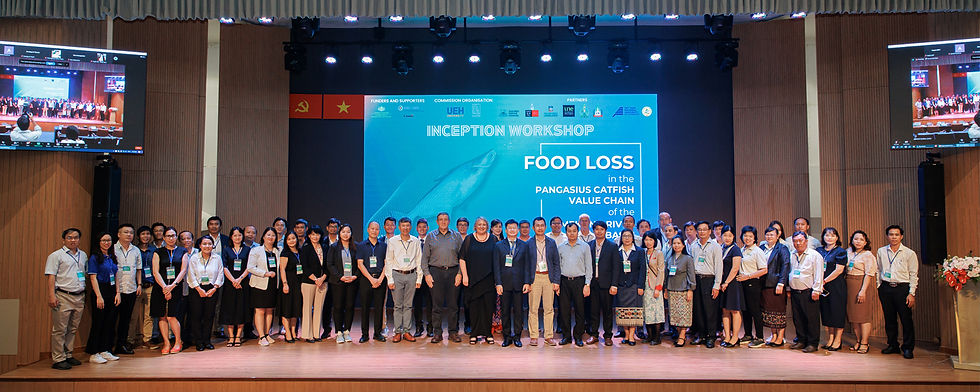
On the morning of 5 May 2026, in Long Xuyen ward, the Health and Agricultural Policy Research Institute (HAPRI) of the University of Economics Ho Chi Minh City (UEH) hosted a workshop to present the results of its research project “Food loss in the Pangasius Catfish Value Chain of the Mekong River Basin” and to consult the project’s stakeholders.
The session brought together a wide cross-section of the industry. Assoc. Prof. Dr. Vo Tat Thang, Director of HAPRI, was joined by representatives of state management agencies, research institutes and universities, industry associations, businesses, processing facilities, traders and collectors, transporters, pangasius farming households, scientists, and independent experts.
A three-year study of where value is lost
The research project, “Food loss in the Pangasius Catfish Value Chain of the Mekong River Basin” (ACIAR project code CS/2020/209), was approved by Vietnam’s Ministry of Education and Training in August 2022. It is supported under the Food Loss Research Program, a partnership between the Australian Centre for International Agricultural Research (ACIAR), the Australian Government’s agricultural research-for-development agency, and Canada’s International Development Research Centre (IDRC). The project runs from 1 April 2023 to 30 June 2026, with a total budget of VND 9.1 billion, and draws on a network of research partners, regulators, businesses, and communities of practice across the pangasius sector.
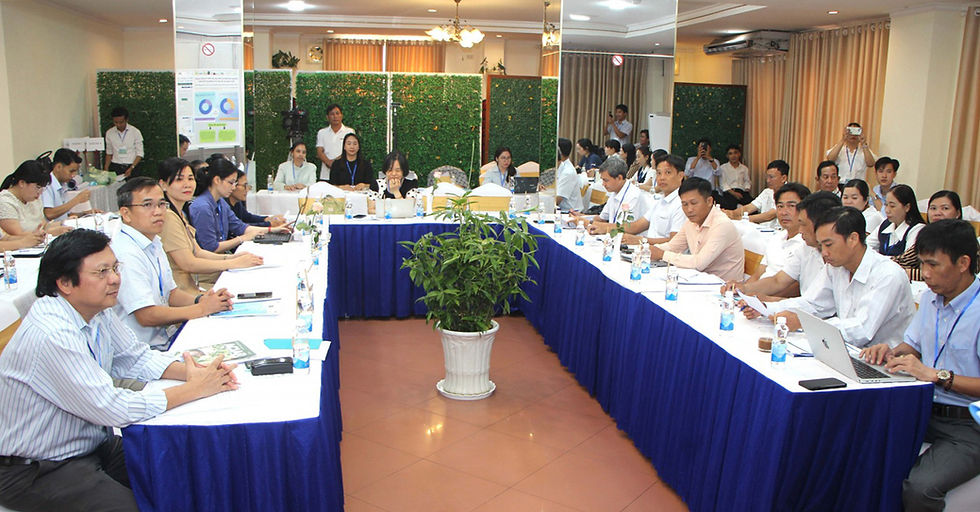
Stakeholders work through a group exercise at the project workshop in Long Xuyen, 5 May 2026. A participant presents his group's findings during the workshop discussion. A participant presents her group's findings during the workshop discussion. The opening slide of HAPRI's project results presentation (ACIAR project CS/2020/209). A farm worker lifts a market-size pangasius during harvest at a Mekong Delta grow-out facility. Project researchers interview a catfish farmer during field data collection; the board behind record The research team tours a covered aquaculture facility during a project field visit. An aquaculture pond fringed by coconut palms in the Mekong Delta.
The study set out to map where, and how, value is lost along the chain. Its findings give a clearer picture of the forms of loss occurring now, and likely to occur in the future, in the Mekong Delta’s pangasius chain: physical loss, loss of quality, loss of economic value, and risks tied to nutrition and the environment.
Crucially, the research shows that loss is not concentrated at any single point. It is distributed across many links of the chain: broodstock and seed, fingerling nursing, grow-out farming, harvesting, transport, processing, and distribution. Tackling it therefore calls for action at every stage, not a fix aimed at one.
Loss is not concentrated at any single point. It is distributed across many links of the chain, from broodstock and seed to final distribution.

From cost competition to sustainable value
Drawing on the findings, delegates proposed a synchronized package of solutions. Its core elements are raising the quality of broodstock and seed, standardizing technical procedures along the chain, and strengthening the linkages between the parties who depend on one another, from farmers to processors to exporters.
Participants also agreed on a broader shift in mindset. Moving away from competition built on the lowest possible cost, and toward the deliberate creation of sustainable value, would help reduce risk and lift the standing of Vietnam’s pangasius industry in international markets.

A strategic commodity facing real pressures
Speaking at the workshop, Assoc. Prof. Dr. Vo Tat Thang, Director of HAPRI, emphasized that pangasius is a strategic commodity for the Mekong Delta. It is a major contributor to Vietnam’s exports and to the livelihoods of people across the region.
Yet the industry’s achievements sit alongside genuine pressures. He pointed to price volatility, increasingly demanding international standards, climate change, and waste along the value chain as the central challenges the sector must now manage.
The project’s results, he noted, are designed to deliver practical benefits to farmers, businesses, and regulators alike, through effective, well-targeted interventions that support a greener and more sustainable pangasius industry.

This post is HAPRI’s own account of a HAPRI-hosted event. The workshop was also covered by Báo An Giang (report and photographs by reporter Hanh Chau, 5 May 2026). Full details of the research project are published by ACIAR: Food Loss in the Pangasius Catfish Value Chain of the Mekong River Basin (CS/2020/209).