Find a Fulbright Grantee: the free tool that maps 59,070 alumni paths
- 3 hours ago
- 8 min read
A free HAPRI tool that turns 59,070 public Fulbright records into a map of your path, and the alumni who already walked it.
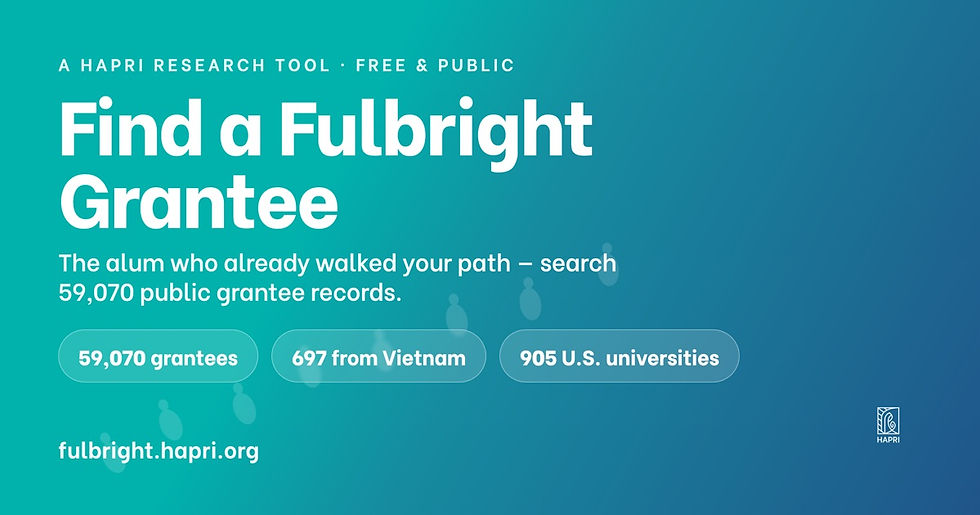
Somewhere in the public Fulbright directory is a person who already walked the path you want: same field, a school you're dreaming about, a country like yours. Most applicants never find that person. They write into a vacuum, guessing at what a strong study objective looks like, guessing at which U.S. departments fit their field, guessing at whether the dream is even realistic, because the people who could answer feel out of reach.
They aren't. There are 59,070 of them, and they are already public. For a nervous applicant, that is the moment Fulbright stops being a door for other people and becomes a road, one with footprints already on it.
At a glance
Tool | Find a Fulbright grantee, free and entirely in your browser |
Built on | The public Fulbright Foreign Student Grantee Directory |
Coverage | 59,070 grantees, 1976 to 2025, 905 U.S. host universities |
From Vietnam | 697 (647 Foreign Student and 50 FLTA) |
Data as of | 2026-06-10, refreshed monthly |
Three views | Explore, By name, and By school |
Cost and privacy | Free, no sign-up, no login, no tracking |
Open it |
What it is
Find a Fulbright grantee is a free, browser-based tool we built on top of the public Fulbright Foreign Student Grantee Directory, the worldwide list of people who came to the United States to study or do research on a Fulbright grant. It covers 59,070 grantees, grant years 1976 to 2025, across 905 U.S. host universities, including 697 from Vietnam (647 Foreign Student grantees and 50 FLTA, Foreign Language Teaching Assistants).

The tool opens on South-eastern Asia with Vietnam pre-selected, 697 grantees, with filters for field, grant year, and grantee type, across three views: Explore, By name, and By school.
Each record shows exactly what the public directory shows: a grantee's name, grantee type, grant year, field of study (grouped into clusters), home country, and the U.S. host university with its city and state. Nothing more: no contact details, no private information, and nothing about what anyone did after their grant.
How to use it for your own path
Say you are a Vietnamese student drawn to public policy, unsure whether the dream is realistic or what it looks like in practice. Here is a five-minute walkthrough; do it now.
Open the Explore page at hapri.org/projects/fulbright-data. It opens on South-eastern Asia with Vietnam already selected; click Just my country to focus on Vietnam, and you're home.
Set the field filter to Public Administration & Policy. You will see the 58 Vietnamese grantees who took that exact path. "A policy person from Vietnam" is no longer hypothetical: there are 58 of them.
Read the brief at the top, a plain-language summary of who went where, written so you can reason about it, not just a table.
Scan the recent grantees, real people, listed by name, field, school. This is where abstract ambition turns into "a person like me did this."
Widen the year range to see how the pattern has shifted: which schools opened up recently, which fields are growing.

Set the field to Public Administration & Policy and the directory narrows to the 58 Vietnamese Foreign Student grantees who took that exact path, with Syracuse (13), Harvard (9), and Indiana-Bloomington (4) as their top hosts.
Zoom out, and Vietnam's overall shape is clear: the most common fields are Business (115), Political & International Studies (70), Public Administration & Policy (58), Economics & Finance (55), and Journalism & Communications (55). Then cross-check on the By school view: open Syracuse's card to see which fields it has hosted and how many. Now you know not just where Vietnamese students go, but where your field goes.

The Vietnam brief, FLTA and Foreign Student side by side. Among the 647 Foreign Student grantees (1992 to 2025), the most common fields are Business (115), Political & International Studies (70), and Public Administration & Policy (58); across all 697 Vietnamese grantees the top host schools are Syracuse (27), Columbia (22), and Harvard (17), drawn straight from the public directory.
Browse by U.S. school
The By school view flips the directory around. Instead of starting from your country, you start from the 905 U.S. universities that have hosted Fulbright grantees: search any of them, sort by how many came from Vietnam, or click a state on the U.S. map. Open a school and you get its full story, how many grantees it has hosted, how many from Vietnam, the fields they studied, and the named alumni who went there.
A walk through the By school view: browse 905 host universities on the U.S. state map, then open a card (here Syracuse and Columbia) to see grantee counts, top fields, and the Vietnamese alumni who studied there.
Find your future mentor
This is the part we care about most.
A directory of names is useful. A directory of role-models you can actually learn from is something else. When you find an alum whose path resembles the one you want, same field, a school you are drawn to, a country like yours, you have found more than a data point. You have found someone who once stood roughly where you stand now. Their trajectory becomes a map.
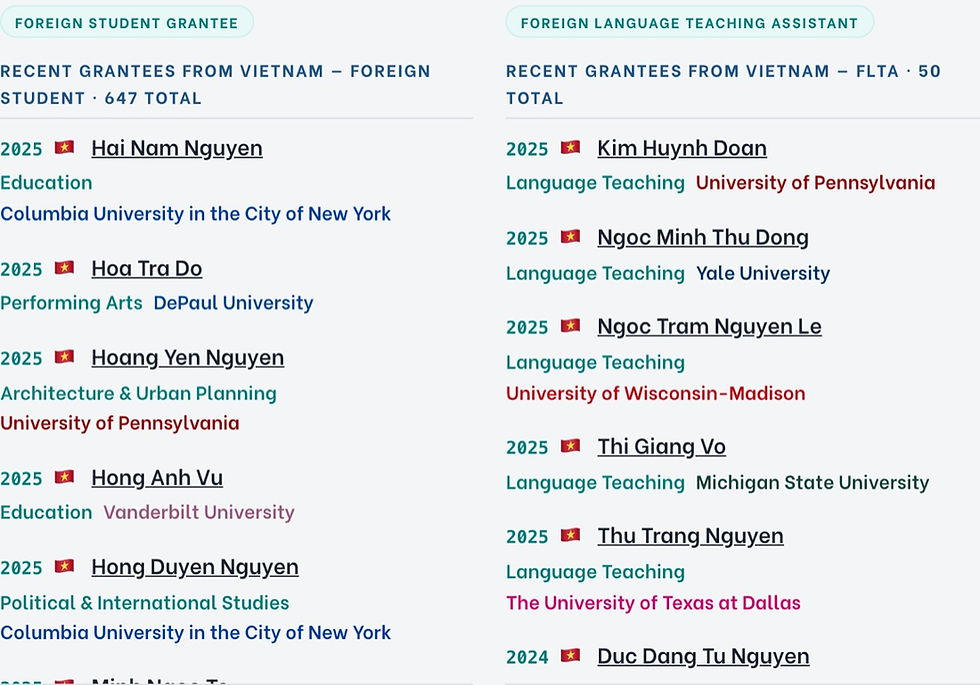
Real grantees, listed by name, field, and host university: the moment abstract ambition turns into 'a person like me did this.'
Three ways to surface them:
Filter Explore down to your field and country to surface alumni whose paths resemble yours.
Search By name to look up a specific person or a family name.
Browse By school to open a university's card and find the alum who studied your subject on the campus you are eyeing.

A school card, Syracuse University: 581 grantees, 27 from Vietnam, the fields they studied, and named Vietnamese alumni you can look up by name.
Now, plainly, about what the tool does and does not do, because we built it to be honest:
It helps you identify people; it does not connect you to them. It does not store, show, or provide anyone's contact details, and it does not message, match, or introduce anyone. There is no "request a mentor" button.
You make the introduction yourself, the way researchers always have, through public, professional channels: LinkedIn, a university faculty or alumni page, an academic conference, or HAPRI's own network.
"Mentor" here is informal, a role-model or advisor you choose to approach, on your own initiative. This is not an official Fulbright matching service, and no one in the directory has agreed to mentor anyone.
You no longer have to imagine your future alone, you can see who has done it, and decide who is worth a respectful note.
A good message is short and specific. Not "will you mentor me," but something like: "I admired your path from public policy to Syracuse, I am applying this cycle, and I would be grateful for ten minutes of your perspective." Some alumni will not have time. Many remember being exactly where you are.

Search by name: 'Nguyen' returns 220 matches, each card showing field, university, and grant year. Public information only; the tool shows no contact details.
Why you can trust it
HAPRI's line is human rigor, machine scale, and this tool is that line applied to one stubborn problem: turning a flat public directory into something a single applicant can learn from.
Public data only. Everything the tool surfaces is already public in the Fulbright directory. We add nothing private.
Private by design. No sign-up, no login, no tracking: it all runs in your browser. We don't see what you search, and we don't want to.
Open methodology. We are transparent about how the directory is gathered, grouped into fields, and counted, so the numbers are checkable, not a black box.
One honest caveat: the patterns above describe what has happened; they don't guarantee what will. Studying a popular field or applying to a common host school is no shortcut to a Fulbright, nothing is. Treat the map as orientation, not a formula.
Start with one search
If you take one action today, make it this: open the tool at hapri.org/projects/fulbright-data, find one alum whose path you wish were yours, and write down their name. That is the beginning of a plan.
The map is already drawn by the 697 Vietnamese, and the tens of thousands worldwide, who went before you. Find your path on it, then find the person who can help you walk it.
Frequently asked questions
Is the Find a Fulbright Grantee tool free?
Yes. It is completely free with no sign-up, no login, and no payment. It runs entirely in your browser, and nothing you type or filter ever leaves your device, with no tracking.
Is this tool affiliated with or endorsed by the Fulbright Program?
No. Find a Fulbright Grantee is an independent research tool built by HAPRI (the Health and Agricultural Policy Research Institute), a university-hosted research institute and NGO in Ho Chi Minh City, Vietnam. It is built on the public Fulbright Foreign Student Grantee Directory but is not run by, affiliated with, or endorsed by the Fulbright Program or the U.S. Department of State. Always confirm program rules and deadlines through the official Fulbright sources for your country.
Where does the data come from, and how current is it?
It is built entirely on the public Fulbright Foreign Student Grantee Directory, which covers grantees who came to the United States (not U.S. citizens who went abroad). The current snapshot holds 59,070 grantee records spanning grant years 1976 to 2025, across 905 U.S. host universities, and is refreshed monthly (snapshot date 2026-06-10). Some directory records may be incomplete.
Does the tool show grantees' contact details, like email or phone?
No. The tool only identifies grantees from the public directory and shows public facts such as their name, country, field of study, host university, and grant year. It does not store, show, or provide any contact details, and it does not message, match, or introduce anyone.
How many Fulbright grantees from Vietnam are in the directory?
As of the 2026-06-10 snapshot, there are 697 grantees from Vietnam: 647 Foreign Student grantees plus 50 Foreign Language Teaching Assistants (FLTA). Their most common fields are Business (115), Political & International Studies (70), and Public Administration & Policy (58), and their top host universities are Syracuse (27), Columbia (22), and Harvard (17). These counts are computed live from the records, so they update with each monthly refresh.
Can the tool connect me with a Fulbright mentor?
No, not directly. The tool helps you discover real grantees from your country, field, or target university from public data, but it does not contact, match, or introduce anyone on your behalf. If you want to reach out, you do that yourself through public channels such as a university alumni network or a professional profile. Here, "mentor" means an informal role model you might learn from, not an official matching or introduction service.
What can I actually do with the tool when applying for a Fulbright?
It has three views. Explore lets you read your country's story (how many grantees, top fields, and top host universities). By school helps you build a shortlist of U.S. universities relevant to your country and field for your study plan. By name lets you look up a specific grantee. It shows the real historical record as context for your decision; it does not predict your chances of being selected.
About HAPRI
HAPRI is the Health and Agricultural Policy Research Institute. It builds open, free tools that turn public data into something a single person can act on, and it shares Find a Fulbright grantee so that prospective applicants in Vietnam and beyond can learn from the people who came before them.
Find a Fulbright grantee is an independent HAPRI project built on the public Fulbright Foreign Student Grantee Directory. It is not affiliated with or endorsed by the Fulbright Program.