
ASEAN's Economic Security Under Pressure from Geopolitical Competition
- 1 day ago
- 2 min read
A new paper in East Asia, co-authored by HAPRI's Huy Quynh Nguyen with Phi Dinh Hoang, argues that great-power competition is threatening ASEAN's economic security by restricting the region's access to advanced technology. Its answer is not retreat but preparation: a structured strategy for anticipating, absorbing and recovering from economic-security shocks.
Context
ASEAN's growth model was built for an open world — one in which goods, capital and technology moved across borders with relatively little friction. That world is under strain. Rising protectionism, trade wars and the prospect of major economies decoupling from one another all bear directly on the foundations of the region's economic success, and economic security has moved from a specialist concern to a leadership-level question for scholars and governments alike.
The paper enters this debate to take stock. Rather than treating economic security as a slogan, it asks what the concept currently means, where the literature stands, and what the prospects are for countries whose prosperity depends on staying plugged into global production and technology networks.
Methods
This is a conceptual contribution rather than an empirical one. The paper works through the existing economic-security literature to clarify the status and prospects of the concept, situates ASEAN within the strategic competition among major powers, and draws on the idea of securitization — the degree to which an economic issue is treated as a security matter — to organise how governments might respond.
Key findings
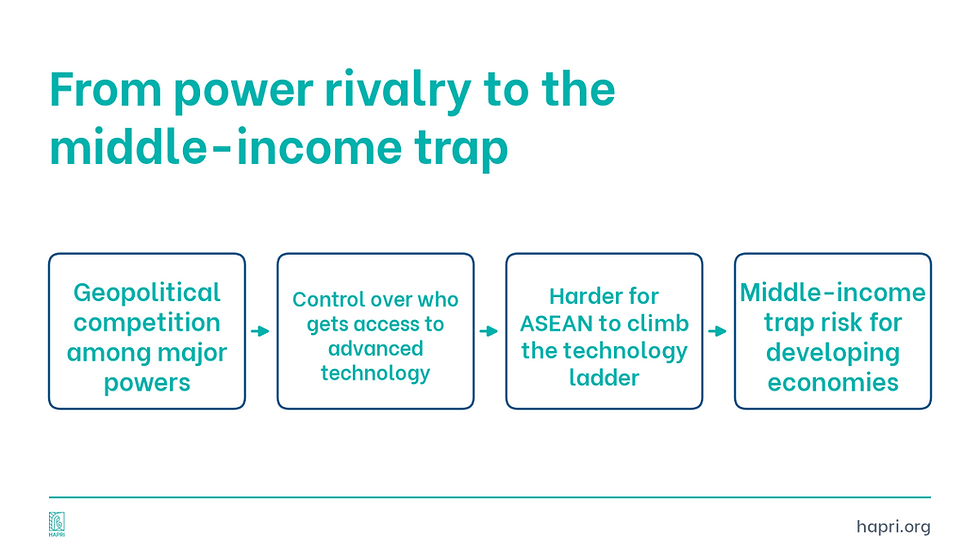
Strategic shifts driven by great-power competition have put ASEAN's economic security at risk, above all through control over who gets access to advanced technology.
If Southeast Asia's developing economies cannot climb the technology ladder, they face the prospect of the middle-income trap.
The paper sets out a management framework built around prevention — early warning, intervention, mitigation and adaptation, followed by preparedness for response and recovery.
Making such a strategy work means being explicit about who the key actors are, how far the issue should be treated as a security matter, and how severely particular threats bear on economic security.

Keywords:
Economic Security
ASEAN
Geopolitical Risk
Technology Access
Middle-Income Trap
Securitization
Link:
Citation:
Hoang, P. D., & Nguyen, H. Q. (2025). Economic Security and Challenges for ASEAN Countries Amid Rising Geopolitical Risk. East Asia, 42(4), 473-488.


