
Gender-Equal Pay Laws May Have an Unexpected Effect on the Shadow Economy

Laws mandating gender-equal pay for work of equal value appear to reduce the size of the shadow economy, according to a new HAPRI study of 162 countries co-authored by Nguyen Doan, Canh Phuc Nguyen (HAPRI Senior Research Associate), Huong Doan and Binh Quang Nguyen. The authors find that such laws also increase male labour force participation, which creates other challenges for policymakers, who need to assess whether employment laws achieve their initial target of supporting disadvantaged female workers in the labour market.
Context
Laws mandating non-discrimination on the basis of gender, such as gender-equal pay for work of equal value, are expected to empower women, especially in employment, to achieve gender equality. This study looks for new evidence that such a law might also have unexpected effects, and examines one of them: its link with the shadow economy.

Methods
The authors use data from 162 countries from 1995 to 2018. They measure the shadow economy with two models, multiple indicators and multiple causes (MIMIC) and dynamic general equilibrium (DGE), and use instrumental variable estimates to examine the mechanism behind the result.
Key findings
Laws mandating gender-equal pay for work of equal value appear to reduce the size of the shadow economy.
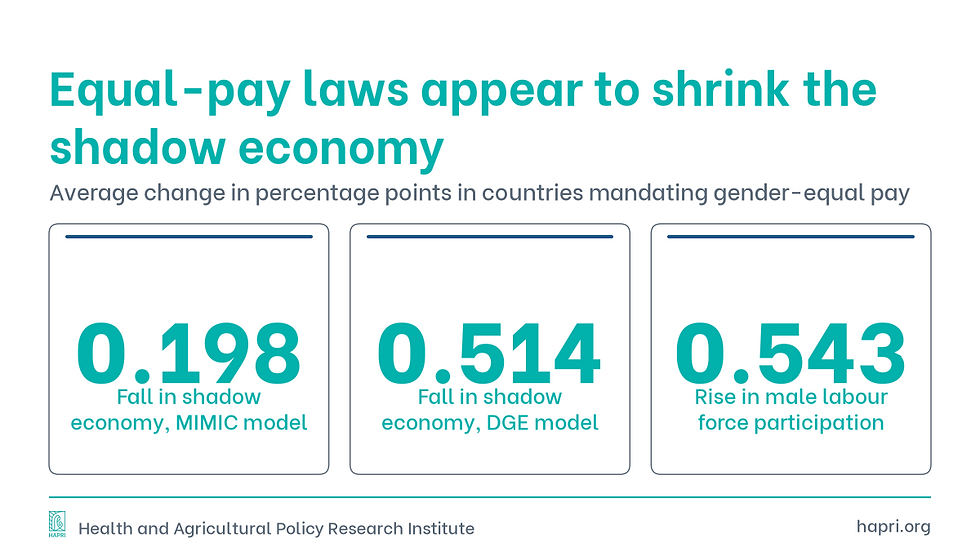
On average, the shadow economy reduces by 0.198 percentage points as measured by the MIMIC model and by 0.514 percentage points as measured by the DGE model in countries mandating gender-equal pay for work of equal value.
Such laws also increase male labour force participation by 0.543 percentage points.
Instrumental variable estimates confirm that increased male labour force participation is the main mechanism for reducing the shadow economy.

Policy implications
These findings imply that laws requiring equal pay for work of equal value are not only a good actor in harmonizing the shadow economy but also create other challenges for policymakers. These findings imply that policymakers need to assess whether employment laws effectively achieve their initial target of supporting disadvantaged female workers in the labour market.
Keywords:
Shadow Economy
Gender-Equal Pay
Equal Pay Legislation
Male Labour Force Participation
Gender Equality
Link:
Citation:
Doan, N., Nguyen, C. P., Doan, H., & Nguyen, B. Q. (2025). What Is the Unexpected Impact of Mandatory Gender‐Equal Pay for Work of Equal Value on the Shadow Economy?. International Social Science Journal, 75(257), 585-601.


