
Abusive Supervision, Psychological Distress, and Why Public Servants Leave
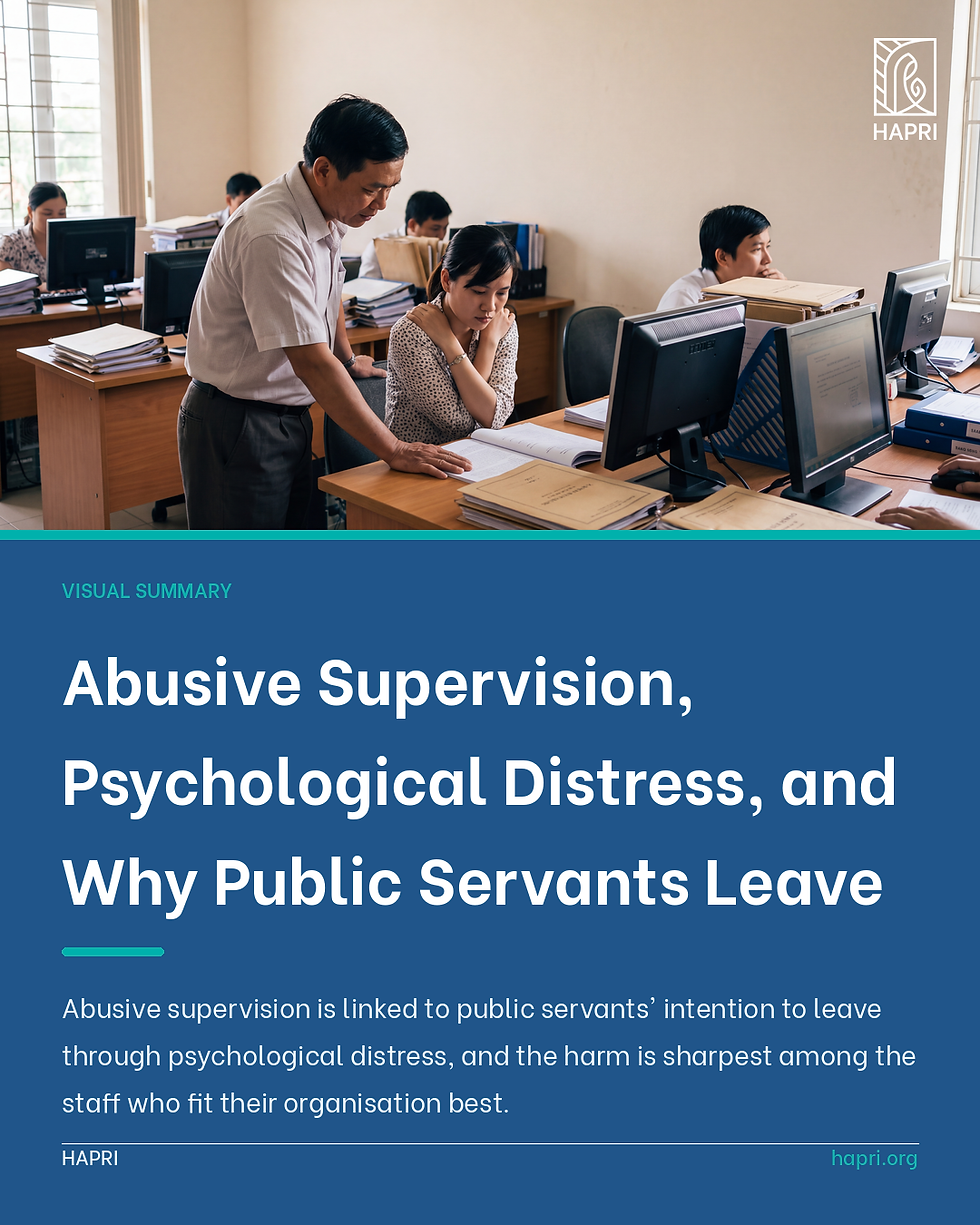

Drawing on a cohort of 468 US public servants, this study finds that abusive supervision is positively related to employees' intention to leave, and that psychological distress is the pathway connecting the two. Strikingly, the damage is greatest among the very people organisations most want to keep — those who fit their organisation well.
Context
Public agencies across many countries face persistent difficulty holding on to skilled staff. Much of the retention conversation focuses on pay, workload and career structure, but the day-to-day conduct of supervisors is a factor that sits closer to the employee's experience of the job — and one that public organisations can act on directly.
This paper approaches that question by bringing together two established perspectives: social cognitive theory, which concerns how people learn from and respond to the behaviour they observe around them, and cognitive dissonance theory, which concerns the discomfort people feel when their experience conflicts with their beliefs about where they work. Reading abusive supervision through both lenses allows the authors to ask not only whether mistreatment pushes public servants toward the exit, but through what mechanism, and for whom.

Methods
The study analyses responses from a cohort of 468 US public servants, using Hayes' Process macro to test a model in which psychological distress carries the effect of abusive supervision onto turnover intention, and person-organization fit conditions how strong that effect is. The approach lets the authors separate the pathway (why abusive supervision translates into wanting to leave) from the boundary condition (which employees react most strongly).
Key findings
Abusive supervision is positively associated with turnover intention, and that association runs through psychological distress — mistreatment first registers as strain, and the strain is what turns into wanting to leave.
The harm is not evenly distributed: the adverse effect of abusive supervision is stronger among subordinates who report a strong person-organization fit.
The study frames abusive supervision as a public-sector retention problem, arguing that positive workplace social connections are a lever for holding on to well-matched personnel.
Theoretically, the paper joins social cognitive and cognitive dissonance accounts to explain how public servants respond to supervisory mistreatment.
Policy implications
The study offers novel insights into retaining well-matched personnel through the cultivation of positive workplace social connections, given the prevailing retention challenges in the public sector.

Keywords:
Abusive Supervision
Turnover Intention
Psychological Distress
Person-Organization Fit
Public Sector Retention
Link:
Citation:
Nguyen, N. T. H., Nguyen, D., Teo, S., & Xerri, M. J. (2023). Abusive supervision and turnover intention among public servants: the roles of psychological distress and person-organization fit. Public Management Review, 26(11), 3201-3226.


