
Are Millennials Different? What Federal Data Say About Generational Commitment


Stereotypes about Millennial workers shape public-management conversations far more than evidence does. Comparing U.S. federal employees under 30 across two surveys seven years apart, this study finds Millennials reported slightly higher affective commitment than Generation Xers did at the same age — the opposite of the common assumption.
Context
Claims that younger generations are less loyal, more reward-driven, and less attached to their employers circulate widely in public administration — in hiring debates, retention strategies, and management training. They are rarely tested. The difficulty is that generation and age are entangled: comparing today's twenty-somethings with today's fifty-somethings measures life stage as much as cohort.
The public sector makes this gap more consequential and less studied. Federal agencies compete for early-career talent while managing a workforce spanning several cohorts, and generational assumptions quietly inform how managers design support, rewards, and job content. Grounded in generational theory and psychological contract theory, this study asks whether the differences managers assume exist actually show up in federal employees' affective commitment — their emotional attachment to the organisation.
Methods
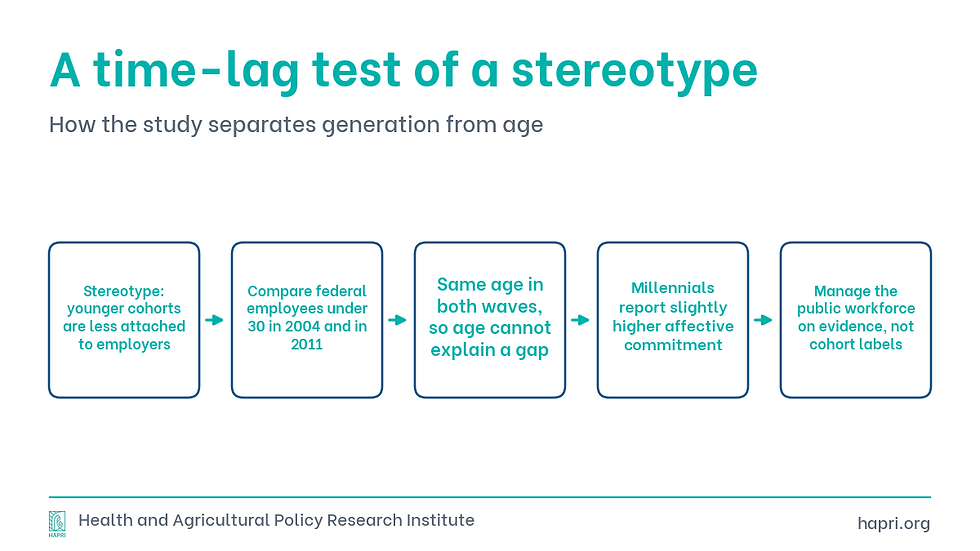
The study uses a time-lag design, which holds age constant and lets cohort vary. It draws on the 2011 Federal Viewpoint Survey and the 2004 Federal Human Capital Survey, restricting both samples to federal employees under 30 years old — Millennials in 2011, Generation Xers in 2004. Comparing two cohorts at the same point in their careers untangles the generational difference from the age difference that confounds most cross-sectional comparisons.
Key findings
Millennial federal employees reported slightly higher affective commitment than Generation Xers at the same age — the reverse of the stereotype that younger cohorts are less attached to their employers.
The study finds no evidence that support for work–life balance, financial rewards, and meaningful work shape affective commitment differently across the two generations — managerial levers appear to work much the same way for both.
Millennials in the federal workforce also reported work interests that depart from the traits commonly attributed to them.
For practice, the results argue for managing the public workforce on evidence rather than cohort labels, which supports both effectiveness and equitable treatment across generations.
Policy implications
The study states that its findings help reduce erroneous stereotypes and foster effective and equitable management of the public workforce.

Keywords:
Affective Commitment
Generational Differences
Millennials
Public Sector Workforce
Psychological Contract Theory
Federal Employees
Link:
Citation:
Nguyen, N. T. H. (2022). Are Millennials Different? A Time-Lag Study of Federal Millennial and Generation X Employees’ Affective Commitment. Public Personnel Management, 52(2), 143-169.


![What motivates farmers to accept good aquaculture practices in development policy? [...]](https://static.wixstatic.com/media/e18ab6_a7ea43d08f474acca16d1a9e3350ee79~mv2.png/v1/fill/w_980,h_552,al_c,q_90,usm_0.66_1.00_0.01,enc_avif,quality_auto/e18ab6_a7ea43d08f474acca16d1a9e3350ee79~mv2.png)